

J&V Elite Motors — SEO
Local SEO and on-page uplift for J&V Elite Motors — top‑5 movement on transactional Dandenong queries, suburb landing pages across the south‑east, and sustained organic visibility backed by qualitative performance reporting.
Automotive & Dealership Marketing
PMGS delivers digital marketing for car dealerships, automotive workshops and parts retailers — SEO for vehicle and service searches, Google Ads targeting buying-intent keywords, social media showcasing inventory and a digital presence that drives showroom traffic.
10+ Automotive Clients | Vehicle Inventory SEO | Google Ads Specialists | Melbourne Based
Most dealership marketing agencies treat Carsales as the enemy. We don't. Carsales captures 70%+ of cold used-car search intent and you can't out-rank it on generic 'used [make] [city]' queries — and you shouldn't try. PMGS structures your own-site SEO and Google Ads to win on the queries Carsales doesn't own: branded searches, service-department demand, finance pages, and the warm + suburb-tuned long-tail.
The automotive buyer journey has shifted dramatically online. Over 90% of car buyers research vehicles online before visiting a dealership. By the time they walk through your door, they’ve already compared models, read reviews, checked inventory and shortlisted dealers. Your digital presence is where the sale begins — or where you lose the customer to a competitor.
Dealerships face a unique challenge: marketing both the brand/model and the specific inventory you have in stock. Vehicle SEO, Google Ads for model-specific searches, social media showcasing new arrivals and a website that makes browsing inventory effortless are all essential.
PMGS builds automotive marketing strategies that drive showroom traffic, test drive bookings and service department revenue. We understand the automotive industry — new vs used inventory, brand requirements, service department marketing and the role of platforms like carsales.com.au.
Every PMGS service adapted for the automotive & car dealership industry.
Industry-specific keyword research, local SEO, technical SEO and content strategy.
Learn MoreGoogle Ads targeting industry-specific high-intent keywords.
Learn MorePlatform selection, content pillars and paid social campaigns.
Learn MoreIndustry-appropriate design, UX and conversion flows.
Learn MoreTechnical builds for industry-specific requirements.
Learn MoreProduct strategy, platform selection and conversion optimisation.
Learn MoreHosting, security and maintenance.
Learn MoreFull-channel coordinated strategy.
Learn MoreWe split the work into three campaign tracks: vehicle sales (new + used inventory pages, Google Vehicle Listings feed, Carsales reconciliation), service department (logbook, parts, repairs — typically the highest-margin track), and finance (novated leases, balloon payments, comparison pages). Each runs on its own attribution and budget so the service department isn't cross-subsidising vehicle ads.
The automotive sector has unique marketing challenges that generic agencies often overlook.
Each vehicle needs to be discoverable online. Vehicle-specific SEO, structured data and dynamic inventory feeds ensure your stock appears in relevant searches.
Over-reliance on carsales.com.au and other listing platforms limits direct enquiries and increases costs. Building your own digital presence reduces dependency and improves margins.
Modern buyers research extensively online before visiting. Your website must pre-sell the visit through detailed inventory, virtual tours, reviews and easy appointment booking.
Dealerships must market both the brand they represent and the specific vehicles they have in stock. Brand awareness campaigns and inventory-specific campaigns serve different purposes.
Servicing, parts and accessories are recurring revenue streams that need their own digital strategy separate from vehicle sales marketing.
Dealership reviews significantly impact buyer confidence. Both sales and service department reviews need active management and generation.
10+
Automotive Clients
200%
Avg. Enquiry Growth
#1
For Dealer Keywords
5 ★
Rated
We work to FCAI guidelines, VFACTS reporting cadences, and PPSR/REVS check disclosures so used-car listings don't trigger ACL claims. We've handled inventory-feed migrations between AutoGate, Cox AutoTrader, and DMS-direct exports.
We benchmark cost-per-test-drive (not cost-per-lead), service-department revenue uplift, and the share of search you've reclaimed from Carsales via Google Vehicle Listings — reported monthly against your DMS.

Dealership SEO, web design and performance results — see full metrics on each case study page.
Playbooks for used-car search, inventory SEO, Google Ads structure and where to invest between listing sites and your own dealership website.

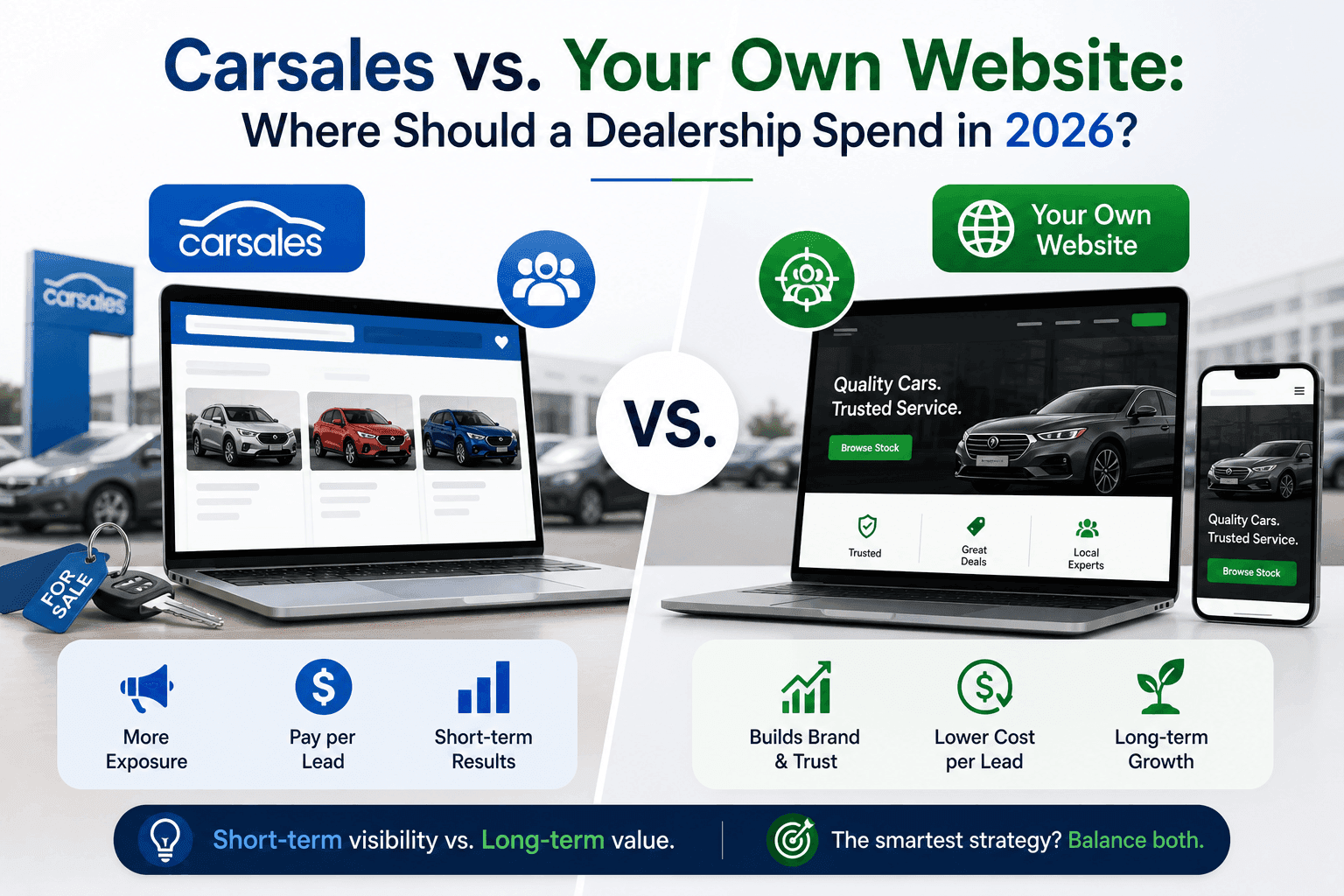
A practical, agency-neutral guide for Australian dealers weighing marketplace spend against owned digital. Real cost comparisons, budget frameworks, and where the ROI actually sits in 2026.
Read more — Carsales vs. Your Own Website: Where Should a Dealership Spend in 2026?
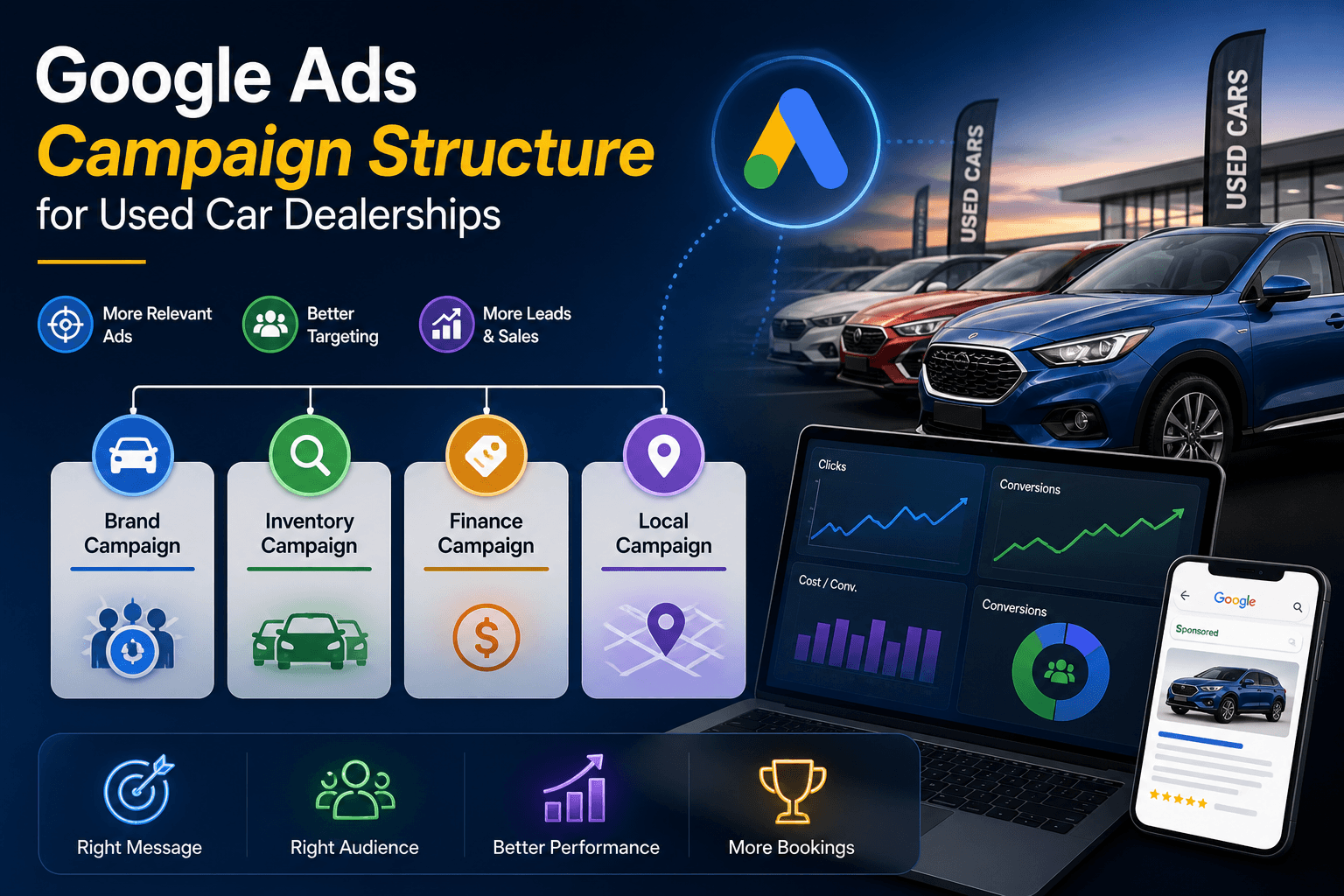
The exact Google Ads campaign structure used car dealerships should run in 2026. Performance Max, Search, Brand, Remarketing — set up, budget split, keyword strategy, and the mistakes that waste 30% of dealer budgets.
Read more — Google Ads Campaign Structure for Used Car Dealerships: A 2026 PlaybookFrom dealer discovery through reporting — built for showrooms, inventory and service departments.
We learn your dealership — brands, inventory, service department, competitive landscape and growth targets.
We analyse competing dealers across Google, social media, carsales presence and advertising.
Tailored automotive strategy covering vehicle SEO, Google Ads, social inventory showcase and service department marketing.
Campaigns launch with inventory-specific targeting and dealer-branded content.
Monthly enquiries, test drives, service bookings, organic traffic and campaign performance.
Tailored digital marketing for every sector — select your industry to see how PMGS can help.


PMGS helps dealerships and automotive businesses grow across Melbourne and Australia with inventory-aware, enquiry-focused marketing.
Common questions about digital marketing for car dealerships and automotive businesses with PMGS.
Three levers: NAP consistency across Carsales, AutoTrader, CarsGuide, your dealer-group page (if franchised), and Google Business Profile; volume of recent reviews mentioning the suburb and the model bought; and on-page proximity signals like the suburb in title, H1, and inventory page URLs. PMGS audits the citation footprint, reconciles Carsales/CarsGuide listings to your GBP, and ships suburb-specific landing pages (e.g. /used-cars-epping/) with structured data so Google can connect inventory to location.
Both, not either. Carsales gets 70%+ of used-car search intent in AU and you can't out-rank it for generic 'used [make/model] [city]' queries. But Carsales takes a lead fee per enquiry and you don't own the relationship. Your own site wins on brand, service department, finance pages, and intent that's further down the funnel ('mazda cx-5 dealer epping', 'logbook service mazda Melbourne'). PMGS structures the strategy so Carsales captures cold demand and your own site captures warm + service-department demand — no cannibalisation.
For a Melbourne used-car dealer, expect $35–$120 per qualified enquiry on Google Ads, depending on inventory price band. Sub-$15k cars run cheaper ($35–$60), $30k+ used cars cost more ($90–$150) because intent is more researched. Service department ads ('logbook service melbourne', 'brake replacement [suburb]') run $20–$45 per enquiry — much cheaper than vehicle ads, and PMGS often recommends starting there to fund the more competitive vehicle campaigns.
Yes — different audience, different keywords, different funnel. Service department marketing targets existing car owners ('logbook service [suburb]', 'brake pads [model]'), runs on a 6–12 month maintenance cycle, and converts at higher rates than vehicle sales. New/used vehicle marketing targets active in-market buyers and converts on a 30–90 day window. PMGS runs them as separate campaign structures with separate landing pages and separate KPIs, so the service department isn't cross-subsidising vehicle sales (or vice versa).
Inventory pages need indexability and structured data (Vehicle / Product schema), but they shouldn't compete with the hub. Optimise the hub for category-level intent ('used cars epping', 'mazda dealer melbourne'), and let inventory pages capture long-tail VIN/stock-number searches. Use canonical tags carefully when stock comes from a feed. PMGS configures the inventory feed (typically AutoGate, Cox AutoTrader, or your DMS export) to populate Google Vehicle Listings and writes the hub copy to capture the head term.
Google Vehicle Listings (rolled out in AU 2024–2025) lets dealers surface inventory directly in Google Search and Maps via structured data — without paying Carsales a lead fee. To qualify, your inventory must be served via a feed (Manufacturer Center) or via Vehicle Listing structured data on each stock page. PMGS sets up the feed, validates each listing in Google's Rich Results Test, and monitors Vehicle Listings impressions in GSC so you can quantify the share of search you've reclaimed from third-party listings.
For a dealership with existing GBP and indexed inventory, expect first attributed test drives at week 6–10, growing through month 4–6. Service department ads convert faster (week 2–4) because intent is more immediate. SEO compounds slowly here because Google weights review volume and location tenure heavily — but the cost per acquired customer drops every quarter as the asset matures. PMGS reports test-drive attribution monthly with call tracking, GA4 events, and your DMS reconciliation.
Yes, with location pages and proximity-tuned content. A dealer in Epping can rank for 'used cars Mill Park', 'used cars Lalor', 'used cars Thomastown' — within ~7–10km — by building one suburb-specific landing page per target suburb (unique copy, suburb in H1/title/URL, real photos at the dealership, local trust signals). Beyond 10km, organic gets thin and paid search makes more sense. PMGS scoped the 20-suburb matrix around PMGS's office in Epping for exactly this reason.
Automotive marketing costs depend on dealership size, inventory volume and competitive intensity. Most dealerships invest $3,000–$8,000/month. PMGS provides transparent pricing with clear deliverables.
Yes. PMGS implements vehicle-specific SEO with structured data (Vehicle schema) for each listing, optimised titles, descriptions and image alt text to rank individual vehicles in Google search results.
By building your dealership's own digital presence — a website with strong SEO, Google Ads capturing model-specific searches, social media showcasing inventory and Google Business Profile optimisation. Over time, direct enquiries grow while platform dependency decreases.
The highest-performing campaigns target model-specific searches ('Toyota HiLux Melbourne'), dealer searches ('car dealer northern suburbs'), used vehicle searches and service-specific queries. Each has dedicated landing pages.
Yes. Service department marketing is often overlooked but represents significant recurring revenue. PMGS creates dedicated campaigns targeting service, parts and accessories searches for your brands.
New vehicles benefit from brand and model campaigns. Used vehicles need inventory-specific SEO with detailed listings. PMGS builds separate strategies for each — often with different budgets and targeting approaches.
Google Ads generates enquiries within the first 1–2 weeks. Organic vehicle visibility builds over 3–6 months. Most dealerships see measurable enquiry growth within 60 days of a coordinated strategy.

Get a free automotive marketing strategy session — we’ll analyse your digital presence, review your competitive landscape and show you how to generate direct enquiries and test drive bookings.