
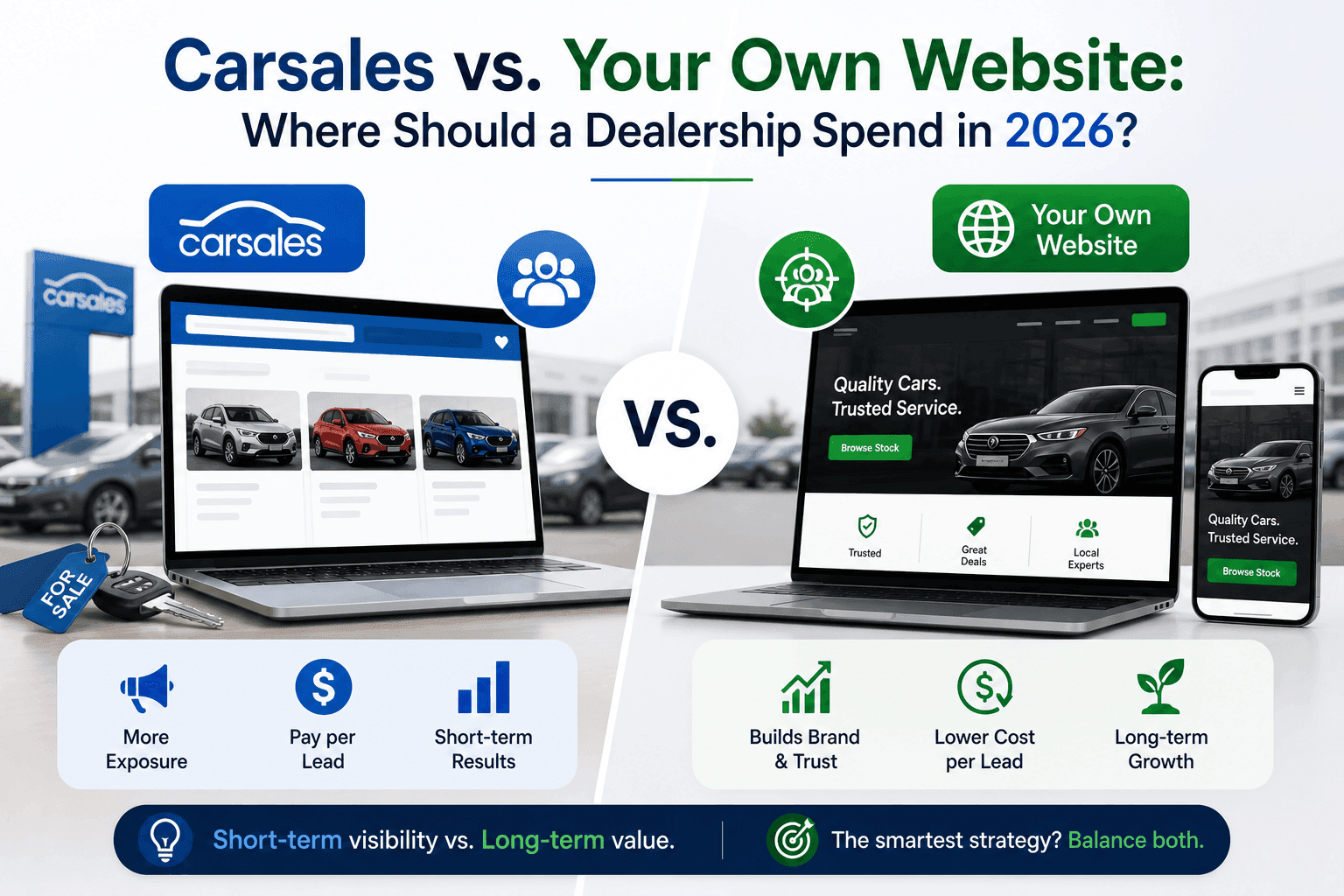
Carsales vs. Your Own Website: Where Should a Dealership Spend in 2026?
Last updated: 5 May 2026 · 9 min read · Automotive marketing
If you run a dealership in Australia, you've probably had the same conversation in the last six months that every dealer principal we speak to has had. Carsales costs keep climbing. Lead quality feels softer. The reps tell you to spend more. And quietly, in the back of your mind, you're wondering whether all that money would do more work somewhere else.
The honest answer to "Carsales or your own website?" isn't an either/or. But it's not "do both equally" either. The dealers winning in 2026 are doing something more deliberate than that — and the gap between them and dealers still pouring 80% of their digital spend into marketplaces is widening every quarter.
This guide breaks down where dealership budgets actually belong in 2026. We'll cover the real cost comparison, the lead-quality difference most dealers underestimate, when Carsales still earns its keep, when your own website wins, and two budget frameworks you can adapt to your situation. No hype, no agency push — just a clear playbook.
The short version (TL;DR)
- Carsales rents you traffic. Your own website builds an audience you own. The difference compounds.
- Marketplace cost-per-lead has roughly doubled in five years — and the lead quality has not.
- Most dealers still spend 70–80% of digital budget on marketplaces. Top performers are at 40–50% and shifting.
- First-party data is the asset under threat from cookie deprecation. Marketplace leads are not first-party data — they're shared.
- Carsales still wins for: aged stock clearance, rapid used-vehicle exposure, low-volume independent dealers needing instant leads.
- Owned website wins for: new car volume, high-margin inventory, brand positioning, long-term cost reduction.
- The right 2026 budget mix depends on your model. Two frameworks (aggressive growth / conservative) inside.
Where we sit: PMGS works with Australian car dealerships across SEO, paid media, and dealership website builds — including some clients still running heavy on Carsales and others who've shifted to owned-first. We have no commercial reason to push you toward one channel; the right answer depends on your inventory, margin, and stage. This guide reflects what we've actually seen work.
The core debate: marketplace vs. ownership
Before we get to budgets, it's worth being precise about what each channel actually is — because the language gets sloppy in this conversation, and sloppy language leads to sloppy spending.
What marketplaces do
Carsales, AutoTrader, CarsGuide, and Drive are aggregator platforms. They build the audience (millions of monthly Australian car shoppers), and dealers pay to display inventory inside that audience. The platform owns the relationship with the buyer. You rent placement.
Why dealers historically depended on them is straightforward:
- They built the largest pre-built audience of in-market car buyers in Australia
- Search intent is high — people on Carsales are usually weeks away from buying
- It works without a marketing team — list, pay, get leads
- For two decades, it was genuinely the lowest-friction lead source for most dealers
What's changed
Three things have shifted the economics, and they're shifting in the same direction.
Rising costs. Listing fees, premium placements, and lead-pass-through pricing have climbed materially over the last five years. Most dealers we talk to report a near-doubling of cost-per-lead since 2020.
Limited differentiation. On a marketplace, your VW Tiguan looks identical to the next dealer's VW Tiguan. Brand, service, finance offer, trade-in process — none of it shows up. You compete almost entirely on price.
Lead ownership. The lead is the platform's, not yours. They control re-marketing, repeat exposure, and the relationship after the first contact. You get a phone call or an email — not a customer asset.
The renting analogy
If you've ever leased a commercial property compared to owning one, the parallel writes itself. Renting is fast, flexible, and predictable. Stop paying the rent and the customer stops walking through the door. Owning is slower, costs more upfront, and pays back over years. Both have a role. Most dealers are renting more than they should be.
What "your own website" actually means in 2026
Most dealers' mental picture of "the website" is still a 2015 brochure site — a few pages of inventory, a contact form, and the dealer principal's photo. That's not what we mean.
A modern dealership website is four things at once
-
A search asset — service pages and inventory pages that rank for what local buyers actually search ("used Toyota Camry [suburb]", "new Mazda CX-5 finance", "car dealership Melbourne"). Done well, this is the lowest-cost-per-lead channel a dealership can run.
-
A first-party data engine — every form fill, brochure download, finance enquiry, and booking captured into your CRM. This is the data that survives cookie deprecation. Marketplace leads don't.
-
A conversion machine — every page designed around a single question: how do we get this visitor to enquire, book, or buy? Speed, mobile UX, click-to-call, finance calculators, trade-in tools.
-
A content and authority hub — model comparisons, finance explainers, EV transition content, service guides. The content that now feeds Google AI Overviews and ChatGPT citations — the new front door of search.
Your website is an asset, not an expense
Carsales spend is rent — useful while it lasts, gone the day you stop. Website investment is closer to capex on a property. It costs more upfront, takes longer to deliver, and produces compounding returns for years. By Year 3, the dealers who invested in their site are paying a fraction of what their marketplace-dependent competitors pay per sale.
This is the frame underneath everything else in this guide. If you want to see how PMGS approaches this for dealers specifically, see our automotive marketing services.
The cost comparison most dealers don't run
Here's the side-by-side that matters. Numbers vary by location, brand, and inventory mix, but the directional pattern holds for almost every dealership in Australia.
| Cost factor | Carsales / marketplaces | Your own website (SEO + paid) |
|---|---|---|
| Upfront investment | Low — pay to list | Higher — site, SEO, content |
| Cost per lead (Year 1) | Stable, often $80–$200+ | Higher early, drops fast |
| Cost per lead (Year 3) | Same or worse (CPC inflation) | Materially lower |
| Lead exclusivity | Shared with multiple dealers | Yours only |
| Differentiation | Almost none — price-led | Full — brand, offer, service |
| Data ownership | Platform owns the audience | You own first-party data |
| Compounding | None — flat over time | Strong — improves with content |
| Predictability | High in short term | Improves after 4–6 months |
| Stops when you stop paying? | Yes, immediately | No — organic continues |
The line that matters most
Year 1, marketplaces almost always look cheaper. Year 3, they almost always look expensive. This is the trap that catches most dealers — they look at month-one cost-per-lead, declare the website "too expensive", and stay on the rental treadmill for another five years. Cost-per-lead from a mature owned channel often sits at a fraction of marketplace cost-per-lead, but the dealer never gets there because they never invested long enough to compound.
Lead quality vs. lead ownership
The cost-per-lead conversation is only half the story. The other half — the half most dealers underestimate — is what kind of lead you're actually buying.
Marketplace leads
- Shared. That same buyer often clicks "enquire" on three or four dealers' listings within minutes. You're racing two competitors to the phone.
- Price-sensitive. The buyer found you by sorting cheapest-to-most-expensive. Margin is already compressed before you've said hello.
- Brand-anonymous. They didn't choose you. They chose the car. They might walk into your competitor tomorrow on a $200 price difference.
- Single-touch. You can't easily re-market to them. You don't own the relationship.
Website leads
- Exclusive. They came to your site, saw your inventory, and chose to enquire with you specifically.
- Brand-aware. They've already engaged with your dealership's content, photos, finance terms, reviews. They know who you are before they pick up the phone.
- Higher intent on margin and service, not just price. Often they're willing to pay a premium for a brand they trust.
- Yours to nurture. You can re-market, send finance updates, invite them to events, follow up at 30/60/90 days. The relationship is yours.
The renting line — sharper this time
You don't own marketplace traffic. You borrow it from a company whose business model depends on staying between you and your customer. That's not a moral problem; it's a structural one. Every marketplace dollar is rent on someone else's audience. Every website dollar builds your own.
The 2026 strategic shift
Three forces are reshaping where dealership budgets need to land, and they're all pulling in the same direction.
1. First-party data is now strategic
Third-party cookies are gone or going across most major browsers. The data dealers used to rely on for retargeting and audience-building — anonymous behavioural data tracked across the web — is no longer reliably available. What's replacing it is first-party data: the leads, accounts, and CRM contacts you collect on your own properties. Marketplace leads are not first-party data. They're a transactional handoff. The dealers building first-party data assets now will have something the dealers leaning on marketplaces won't: a marketing list they fully control.
2. CPCs across paid platforms are climbing
Google Ads, Meta, marketplace listing fees — every paid acquisition channel has grown more expensive year over year. Google's Vehicle Ads (inventory-led listings in Google surfaces) are increasingly part of that mix for Australian dealers who want to reach in-market buyers outside marketplaces alone. The dealers shielded from broad CPC pressure are the ones with strong organic search visibility — because organic visits don't carry per-click costs. Owned SEO is the only channel where the cost curve runs the opposite way to the rest of the market.
3. AI search is changing the front door
Google's AI Overviews, ChatGPT, and similar AI search experiences are increasingly the first surface buyers see when they research a vehicle. Marketplace listings rarely get cited in AI Overviews. Dealership content — model comparisons, finance explainers, ownership cost guides — does. The dealers publishing useful content now are the ones AI search will surface for the next decade. The dealers without that content won't show up at all.
Where the trend line points
Five years ago, 70–80% of dealership digital budgets going to marketplaces was normal. Today, it's increasingly a sign of a dealership that hasn't adjusted. The top-performing groups we work with sit at 40–50% marketplace, with the rest going to owned channels. Five years from now, that ratio will probably be 30–35% marketplace for the dealers still in business and growing.
Market context: Australian new vehicle sales trends are published through FCAI's VFACTS new vehicle sales data, with the ABS methodology for sales of new motor vehicles describing how national statistics relate to that industry data.
When Carsales still earns its keep
This isn't a hit piece on Carsales. The platform still does specific jobs better than anything else. Four scenarios where marketplace spend is still the right call.
1. Aged stock clearance
Inventory sitting on the lot for 60+ days is costing you holding fees and tying up capital. Marketplaces are excellent for fast, broad exposure to a price-sensitive audience that will move stale stock. This is where Carsales earns its money for almost every dealership in the country.
2. Rapid exposure for used vehicles
New stock arrives on Tuesday and needs to be visible to thousands of buyers by Wednesday. Marketplaces give you that velocity. Your own SEO won't, no matter how good it is. Use Carsales for time-sensitive exposure; use your site for considered, high-margin sales.
3. Smaller independent dealers needing immediate leads
If you're a small independent without the runway to build SEO over six to twelve months, marketplaces are your fastest path to leads in the door. Build SEO as a parallel investment, but don't starve the present trying to fund the future.
4. Specific volume models with high search demand on platforms
Some models — popular utes, mid-range family SUVs, fleet sedans — get most of their search volume directly on Carsales rather than Google. For these, marketplace presence is genuinely non-negotiable. Other models (luxury, niche, performance, specialty) get more search through Google and your site can compete more effectively.
When your website wins
Four scenarios where investment in your owned digital channels delivers materially better returns than marketplace spend.
1. New car sales and brand positioning
New car buyers research differently. They start at the manufacturer site, compare on aggregator sites, then increasingly want to know who the dealer is — service reputation, finance options, trade-in process, location convenience. Your website is where that decision actually happens. Marketplaces compete on price; your site competes on the full offer.
2. High-margin inventory
Luxury, performance, near-new prestige, and specialty inventory all underperform on marketplaces because they get sorted next to lower-priced alternatives. On your own site, you control presentation, narrative, and positioning. Buyers researching a $90k SUV are not making a $200 price-comparison decision — they're choosing a dealer. That's a website conversation.
3. Long-term growth and lower CPL
If your goal is to be in business in 5 years with lower acquisition costs than today, the website is the asset that delivers that trajectory. Marketplace cost-per-lead trends flat or up. Owned cost-per-lead trends materially down. Same goal — different curves.
4. Local SEO dominance
Buyers searching "used cars Melbourne", "car dealership [suburb]", or "Toyota dealer near me" are not on Carsales when they make those searches — they're on Google. The dealers ranking for those local terms get the call before any marketplace gets considered. This is the cheapest, highest-intent traffic in dealership marketing, and almost every dealership underinvests in it.
Two budget frameworks (pick the one that fits)
There's no universal split. Your stage, inventory, margin, and risk tolerance all change the maths. Here are two frameworks we've used with dealers — one for groups committed to a deliberate shift, one for dealerships that need to keep the lights on while transitioning.
Framework A — Aggressive growth (owned-first)
For dealerships ready to commit to a 12–18 month rebuild of their digital posture. Higher Year 1 investment, materially lower acquisition costs from Year 2 onwards.
| Channel | % of digital budget | What it does |
|---|---|---|
| Website + SEO + content | 50% | Long-term asset; lowest cost-per-lead by Year 2 |
| Carsales + marketplaces | 30% | Aged stock + fast exposure |
| Paid search + social | 20% | Demand capture + retargeting first-party audiences |
Framework B — Conservative (transitional)
For dealerships that can't risk lead volume in the short term. Maintains marketplace dependence while quietly building the owned engine in parallel.
| Channel | % of digital budget | What it does |
|---|---|---|
| Carsales + marketplaces | 60% | Maintains lead volume during transition |
| Website + SEO + content | 30% | Builds the owned engine for Year 2 onwards |
| Experimentation (paid, social, email) | 10% | Tests new channels; protects against single-channel risk |
How to choose between them
Aggressive (50/30/20) works if: you have 12+ months of cash runway, leadership is committed to the transition, current marketplace leads are clearly underperforming, and you're willing to accept a 3–4 month dip while organic catches up.
Conservative (60/30/10) works if: you can't tolerate lead volume risk, you're a smaller dealer with limited overhead, or the dealer principal isn't yet convinced and you're proving the case before pushing harder.
Either way, the trajectory should be the same: shift toward owned over time. The dealers that don't shift at all are the ones in trouble.
Three real-world scenarios
Concrete patterns from dealerships we've worked with or seen up close. Names anonymised; the situations are real.
Scenario 1 — Small independent in Melbourne's outer suburbs
A 40-vehicle used-car independent in Melbourne's outer south-east, dealer principal handles most of the marketing decisions. Currently spending around $4,500/month — 85% of it on Carsales. Lead quality has softened over the last 18 months; some weeks the phone barely rings.
What we'd recommend: Start with Framework B (conservative). Maintain Carsales spend short-term, but redirect 25% of the budget into a website rebuild and local SEO push. Target the 8–10 surrounding suburbs with dedicated location pages. Target 12 months to flip the ratio toward 50/50.
Scenario 2 — Multi-rooftop dealer group with five locations
Mid-size group, mix of franchise and used, $40,000–$60,000 monthly digital spend across all locations. Currently around 70% marketplace, 20% paid search, 10% website. Lead quality reasonable but cost-per-sale rising every quarter.
What we'd recommend: Framework A (aggressive). At this scale, the savings from shifting 30 percentage points of spend from marketplaces to owned channels compounds dramatically over 24 months. Build a centralised SEO and content operation that serves all five rooftops. Build location-specific landing pages for every suburb each rooftop services. Within 18 months, owned should be the dominant lead source.
Scenario 3 — Luxury / prestige dealership
Single-rooftop premium European franchise. Inventory averages $80k+. Marketplace leads have always been low-value — the buyer profile doesn't match. Currently 40% marketplace, 30% Google Ads, 30% website.
What we'd recommend: Push further into owned. Framework A on steroids — closer to 60% website + SEO, 20% paid search (brand-defence and high-intent terms), 20% targeted social and YouTube for brand. For luxury, marketplaces add little. The buyer is researching the brand, the dealer reputation, and the ownership experience — all of which lives on owned channels.
Five mistakes that keep dealers stuck
The patterns we see most often when dealerships get stuck on the marketplace treadmill.
-
Over-reliance on a single platform — Eighty percent of leads from one source is single-channel risk dressed up as a strategy. The day Carsales raises rates 15% (which they will, eventually), you have no leverage and no alternative.
-
Treating the website as "set and forget" — A dealership site built three years ago and never updated isn't an asset — it's a depreciating brochure. Inventory pages need to be refreshed, content needs to be added, technical SEO needs maintenance, conversion rate needs testing. The dealers winning on owned channels treat the site as a living operation, not a one-off project.
-
Ignoring SEO entirely — "We don't really do SEO" is something we still hear from dealers spending $10k a month on Carsales. SEO is the channel that delivers the lowest cost-per-lead in the long run. Skipping it isn't saving money — it's leaving the cheapest lead source on the table.
-
Not tracking lead source properly — If you can't tell which channel produced which sale, you're optimising blind. We routinely audit dealerships where the marketplace lead is being credited with sales the website actually drove (or vice versa). Without proper attribution — call tracking, form source tracking, CRM integration — you can't tell what's working.
-
Underinvesting in the inventory page experience — Dealership sites consistently put the most generic experience in front of the highest-intent traffic. Inventory pages should be the strongest pages on the site — high-quality photos, detailed specs, finance calculator, click-to-call, related vehicles, social proof. Most are bare-bones. Fix this and conversion rate often doubles before you spend a dollar more on traffic.
What top-performing dealerships do differently
From observation across the dealers we work with and the data we see, four behaviours separate the top performers from the rest.
-
They track every lead to source — Call tracking, form attribution, CRM lead-source fields — all in place. They know within a dollar what each channel costs them per sale, and they shift budget accordingly every month.
-
They invest in their site as a real channel, not a digital business card — Site redesigned every 2–3 years, content added monthly, SEO worked on continuously, inventory pages treated as the highest-priority real estate on the property.
-
They use marketplaces tactically, not strategically — Carsales is for aged stock and rapid exposure. It's not the centre of the strategy. The centre is owned audience and first-party data.
-
They build content that ranks and gets cited — Model comparisons, ownership cost guides, finance explainers, EV transition content. The content that ranks on Google, gets cited in AI Overviews, and brings in considered buyers months before they're ready to walk into a showroom.
Frequently asked questions
Is Carsales worth it for dealers in 2026?
Yes — but with a smaller share of your budget than most dealers currently allocate. Carsales still does specific jobs well: aged stock clearance, rapid used-vehicle exposure, and lead volume for smaller independent dealers without owned-channel infrastructure. What's changed is that it's no longer the highest-ROI channel for most dealerships. Top performers now run Carsales at 30–50% of digital spend, with the rest going to owned website, SEO, and direct paid acquisition.
How do dealerships generate leads without Carsales?
The strongest non-marketplace lead channels for Australian dealerships are: organic search via SEO (especially local SEO for suburb-level queries), Google Ads targeting high-intent inventory and finance keywords, dealership website conversion-optimised inventory pages, Meta and YouTube advertising for brand and consideration, email marketing to first-party CRM lists, and Google Business Profile for local discovery. Most dealers running multi-channel without heavy Carsales reliance use a combination of SEO, paid search, and CRM-driven email.
How much should a dealership spend on marketing in Australia?
Most Australian dealerships spend between 0.8% and 1.5% of total revenue on marketing, though this varies widely by franchise model, used-vs-new mix, and location. Independent used-car dealers often spend a higher percentage of revenue but a lower absolute dollar figure. The more useful question than "how much" is "on what" — a dealership spending 1% of revenue almost entirely on marketplaces is usually performing worse than one spending 0.8% across a balanced owned-and-paid mix.
What is the best website strategy for car dealers in 2026?
Four pillars: fast, mobile-first inventory pages with strong photography and conversion elements (finance calculator, click-to-call, trade-in tool); local SEO targeting suburb-level searches; content that captures consideration-stage buyers (model comparisons, finance and ownership cost guides, EV transition content); and first-party data capture connected to a CRM. The website should feel like a sales tool, not a brochure. Page speed under 2 seconds on mobile, conversion rate above 4%, and inventory updated daily are the baseline benchmarks.
Do dealership websites actually convert?
Yes — well-built dealership websites typically convert 3–6% of unique visitors into enquiries (form fills, phone calls, finance applications). Poorly built sites convert at well under 1%. The variance is almost entirely about UX and conversion design, not traffic volume. A dealership site converting at 4% will generate more enquiries from 5,000 monthly visits than a site converting at 1% from 15,000 visits — and at a fraction of the marketing spend.
How long does dealership SEO take to deliver leads?
Most dealerships see early local SEO movement within 3–4 months and meaningful organic enquiry volume between months 6 and 12. Suburban and regional dealers in less competitive markets often see results faster (4–6 months). Saturated metro markets like inner Melbourne or Sydney can take 9–12 months for competitive rankings. The compounding effect means Year 2 typically delivers far more organic leads than Year 1, with no extra investment.
Should I cut Carsales completely?
Almost never. Even dealers committed to owned-first strategies usually maintain some marketplace presence for the specific jobs marketplaces still do well — aged stock clearance, rapid used-vehicle exposure, and certain high-volume models that get most of their search on platforms. The shift is a rebalance, not an exit. A complete Carsales exit is appropriate only for some luxury dealerships where the buyer profile genuinely doesn't use marketplaces.
What's first-party data and why does it matter for dealerships?
First-party data is information you collect directly from your own customers and prospects — names, emails, phone numbers, vehicle interests, finance enquiries, service history. It's data you own, in your own systems. Marketplace leads aren't first-party data — they're transactional handoffs that the platform also retains. As third-party cookies disappear from browsers, first-party data becomes the foundation of effective digital marketing. Dealers building their first-party data assets now will have something dealers leaning on marketplaces won't.
How this plays out — a dealer case snapshot
To make the framework concrete: here's the broad pattern of a Melbourne-area dealership we worked with that shifted from heavy marketplace dependence to a balanced owned-first model over 18 months.
Dealership snapshot
| Profile | Multi-franchise dealer group, three rooftops, Melbourne metro |
| Starting point | 78% marketplace spend, 12% paid search, 10% website (last redesigned 2018) |
| Engagement | 18-month strategic shift toward Framework A |
| Investment | Website rebuild, local SEO across 24 surrounding suburbs, content programme, conversion optimisation, integrated call tracking |
What changed over 18 months
- Marketplace spend dropped from 78% of digital budget to 42%, with no reduction in lead volume
- Website organic enquiries grew from a low baseline to roughly 40% of total dealership leads by Month 18
- Cost-per-lead blended fell by approximately 35% across the engagement period
- First-party CRM list grew from sparse to a meaningful asset — used for finance refresh campaigns, service reminders, and retargeting
- Local search visibility — the group ranked in the top three for the majority of the high-intent suburb-level searches in their service area
For strategy breakdowns and results from similar engagements, browse our automotive case studies — including work such as Elite Motors SEO.
Where to start
If you've read this far, you're probably already mostly convinced that the marketplace-heavy mix isn't where your spend should sit in 2026. The harder question is what to actually do about it.
A reasonable starting point
Three things every dealer can do this quarter, regardless of size:
-
Audit your current lead-source attribution. If you can't tell which channel produced last month's sales, you can't make budget decisions. Fix this first.
-
Run a baseline audit of your dealership website — page speed, mobile UX, inventory page conversion, local SEO visibility. You'll usually find low-hanging fruit worth thousands.
-
Test one suburb-level local SEO push for a single rooftop. If you can rank for "used cars [suburb]" in 4–6 months, you've validated the channel before committing serious budget.
If you'd prefer a hand
PMGS works with Australian dealerships across these exact problems — website rebuilds, dealership SEO, paid search, and channel rebalancing strategy. If you'd like an external view of where your budget is leaking and where the highest-ROI shifts are, we run a free initial digital audit covering your website, marketplace performance, local SEO, and lead-source attribution. No obligation; the report is yours regardless. Learn more about our automotive marketing services.
→ Request a free dealership digital audit
Or read on:
- Local SEO — suburb-level visibility and ranking fundamentals that apply to dealerships
- Conversion rate optimisation — tightening enquiry rates on your site
- Google Ads — demand capture and paid search fundamentals
- Automotive marketing services — services hub
Sources and further reading
- Cox Automotive Australia — dealership and consumer trend reporting
- Australian Automotive Dealer Association (AADA) — industry benchmarks and policy briefings
- Federal Chamber of Automotive Industries (FCAI) — VFACTS — new vehicle sales data
- Google — Search Quality Evaluator Guidelines (E-E-A-T framework)
- Australian Bureau of Statistics — sales of new motor vehicles methodology — national reporting context for automotive market data
Disclaimer: This article provides general strategic guidance for Australian dealerships and is current as of May 2026. Specific cost figures, budget recommendations, and outcomes vary widely by dealership type, location, brand mix, and execution. The frameworks here are starting points, not prescriptions; for tailored guidance, speak with a marketing professional who can assess your specific dealership economics directly.
Reading time: ~9 minutes · Last updated: 5 May 2026
Author

Gayan Perera
Gayan Perera, Senior Digital Marketing Specialist at PMGS Digital since 2010. With a bachelor's degree in online systems, Gayan specialises in Online Systems, Web Development, Google Analytics, SEO, Google Ads, Social Ads and CRM Integrations. In addition to those, Gayan enjoys creating videos and content to educate people about those areas.