
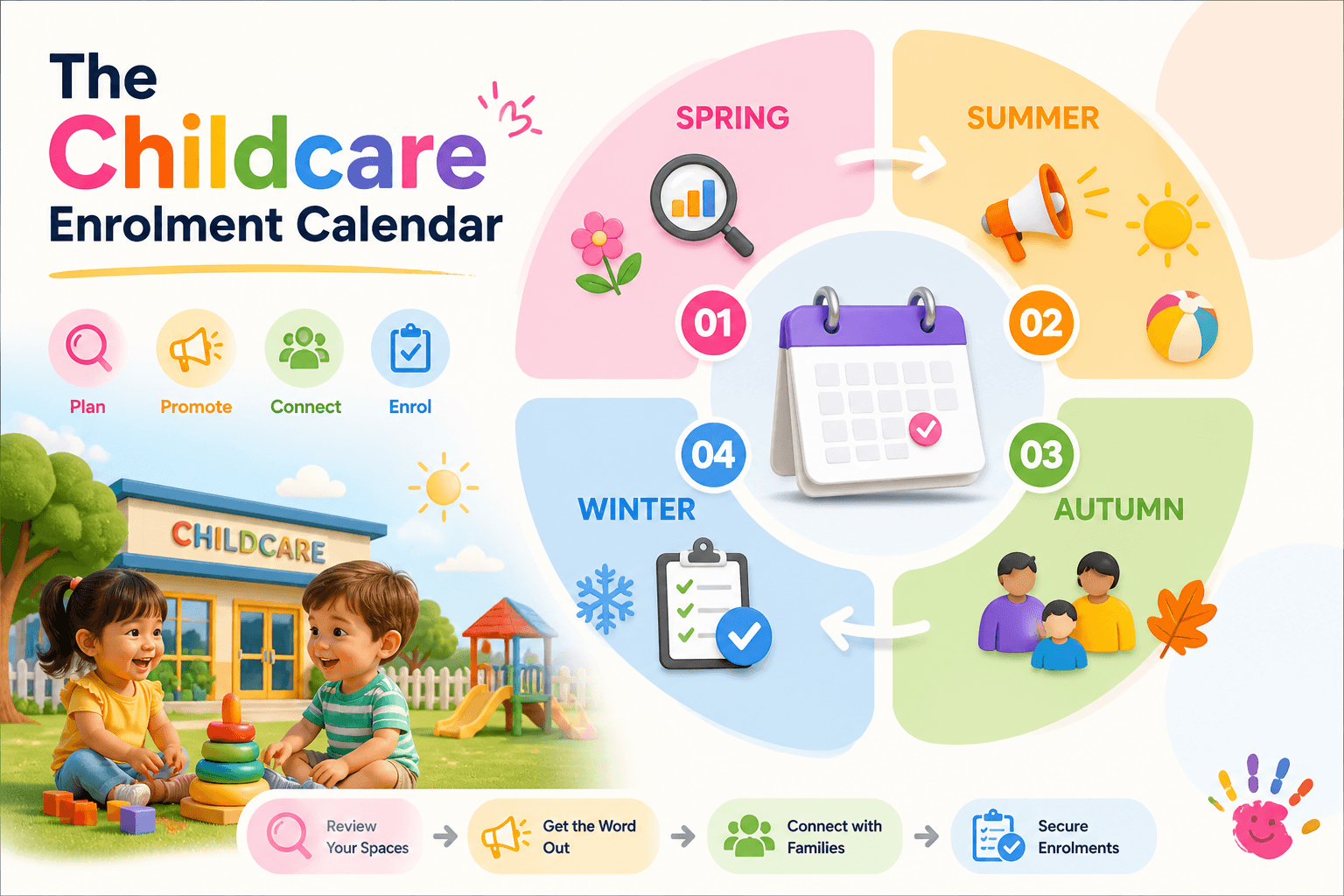
The Childcare Enrolment Calendar: A Month-by-Month Guide for Australian Parents
Last updated: 5 May 2026 · 8 min read · For Australian parents
If you've started thinking about childcare and quickly realised that everyone seems to be telling you something different, you're not alone. Some parents say you should enrol the moment your baby's born. Others swear they found a spot in two weeks. The advice is contradictory because the system itself is messy — and because the timing that works really does depend on where you live, how old your child is, and when you actually need care.
This guide is here to make it simple. We'll walk through the year month by month, so you can see at a glance when most Australian parents are looking, when waitlists fill up, when openings tend to appear, and what to do if you find yourself starting late. No jargon, no scare tactics — just a clear picture of how childcare enrolment actually works in 2026.
Whether you're pregnant and planning ahead, returning to work in six months, or already feeling like you're behind, you'll know exactly what to do by the end of this article.
The short version (TL;DR)
- Most parents should start looking 6–12 months before they need care. Earlier is fine. Later is workable, but harder.
- Peak research period is July to September. Most spots for the following year are decided by November.
- Nursery (0–2 year) places fill fastest — particularly in Melbourne, Sydney, and other capital cities.
- Many centres accept waitlist applications from birth (some even during pregnancy). It's rarely too early.
- Most last-minute spots open in January–February when families relocate or change plans.
- Tour at least 3 centres before joining waitlists. Cultural fit matters as much as availability.
- If you're starting late, don't panic. Casual care, in-home options, and unexpected openings exist — but the more centres you contact, the better your odds.
A note before we start: This is a general guide for Australian parents. Childcare availability varies enormously by suburb, child age, and centre — so the timing that works in inner Melbourne may not match what works in regional Queensland. Use this as a starting framework, not a strict rule.
The big question: when should you actually start?
Here's the honest answer most parents don't get told clearly enough:
Most Australian parents should start looking for childcare 6–12 months before they need it. In high-demand areas — inner Melbourne, Sydney, Brisbane, parts of Perth — that window stretches to 12–18 months. For nursery (0–2 year) places in capital cities, families often join waitlists during pregnancy.
Why so far in advance?
Three things drive the timeline:
-
Demand exceeds supply in most metro areas. There are simply more families wanting care than there are licensed places, especially for younger children.
-
Centres release spots in cycles. Most new vacancies open at the start of the year (when older children move up to school) or when current families' circumstances change.
-
Waitlists are real. They're not just "register your interest" lists — they actually determine who gets a call when a place opens.
How long do parents really wait?
Wait times vary widely. From what families report and what childcare operators tell us:
- Inner-city Melbourne / Sydney nursery rooms: Often 6–18 months. Some popular centres maintain waitlists 2+ years long.
- Suburban / outer metro: Typically 3–9 months for most age groups.
- Regional and rural: Often weeks to a few months. Sometimes immediate.
- Toddler and 3–5 year rooms: Almost always shorter waits than nurseries (more places, fewer babies competing).
How childcare enrolment actually works in Australia
Before the calendar makes sense, it helps to know how the system is structured. There are a few things that surprise most first-time parents.
There's no single national deadline
Unlike school enrolment, there's no government-set cut-off date for childcare. Each centre runs its own waitlist, sets its own offer dates, and decides when spots open. This is partly why timing feels confusing — it genuinely is decentralised.
Centres manage their own waitlists
Some operate strict first-in, first-served lists. Others give priority to siblings of current children. Some have separate lists for different days of the week (more on this below). When you join a waitlist, ask the centre how it works at theirs — the rules vary.
Spots open as children move age groups
Childcare centres are usually structured by age group: nursery (typically 0–2), toddler (2–3), and pre-kindy/kindy (3–5). Spaces become available when:
- Children move up to the next age group (creating a gap below)
- Children leave to start school (creating a gap in the oldest room)
- Families relocate, change days, or withdraw
The biggest wave of new openings happens at the start of each year, around January and February, as the previous year's pre-kindy children leave for school.
Days of the week matter
Two-day-a-week spots (typically Tuesday/Thursday) usually have shorter waitlists than five-day spots, because more families want them. If you can be flexible on which days you need, you'll often get in faster.
The Child Care Subsidy is separate
Worth knowing early: the Child Care Subsidy (CCS) is the federal payment that reduces your out-of-pocket childcare fees. It's administered by Services Australia, and you apply through your Centrelink online account. CCS doesn't determine where or when you can enrol — but you'll want it sorted before your child's first day, because you can't claim it retrospectively for the period before you applied.
From 5 January 2026, the 3 Day Guarantee and broader Child Care Subsidy changes reshape subsidised hours for many families — read Services Australia's overview before you lock in days and budgets. To estimate what you'll pay after subsidy, use the Starting Blocks Child Care Subsidy calculator.
Quick rule: Apply for CCS at the same time you accept a centre's offer, not after care has started.
The month-by-month enrolment calendar
Here's how the year actually unfolds for Australian families looking for care. This isn't a strict rulebook — every family's situation differs — but it's the rhythm most centres and parents follow.
January — Last-minute placements & the start of the year
January is when the system resets. The previous year's pre-kindy children have left for school, creating openings throughout the centre. New families who secured spots back in October are starting their first days. Some families who held places have changed plans, freeing up unexpected vacancies.
If you're starting late, this is one of your two best chances of the year. Call centres directly. Ask if any spots have opened up that haven't made it to the waitlist yet. Be flexible on days.
February–March — Settling-in season
New children settle into their rooms. Educators are running orientation days, easing children into the routine, and not actively looking to enrol more. Most centres pause new offers until the established cohort is comfortable.
Families who didn't secure a spot in January often find this the toughest period. Vacancies are rare. If you're on a waitlist, this is the time to check in politely and confirm your details are current.
April–June — Quiet research season
By April, the academic-year rhythm is settled. Parents who'll need care next January start to look around — quietly at first. Centre tours pick up. Waitlist sign-ups grow. Most centres aren't taking many new starters until later in the year, but they're absolutely taking applications for the following year.
This is a great time to tour multiple centres without pressure. Visit 3–5 places. Ask questions. Make a shortlist before the rush.
July–September — Peak research period
This is when the system gets crowded. Parents returning to work in the new year start booking tours in earnest. Word-of-mouth recommendations move fast. Popular centres start fielding multiple enquiries a day.
If you need care for January next year, this is the latest comfortable time to be on waitlists. By the end of September, many top-choice centres have a clear sense of who they're going to offer places to.
October–November — Decision season
Centres start sending out offers for the following year. Parents accept (or decline). Waitlists shuffle. Families who decline open up spots for the next person on the list. This is when most placements are firmed up.
If you're offered a spot and it's at one of your top choices, accept quickly — many centres only hold offers for 5–7 days. If it's not your first preference, ask whether you can sit on the offer briefly while you wait to hear from another centre. Most are reasonable about a short delay.
December — Final adjustments
December is a quieter month for new enquiries — most families are heading into the holidays. But it's an active month for centres finalising rolls. Last-minute changes, late offers, and confirmation paperwork happen now.
If you're still searching, December is worth one more sweep. Some families' plans change at the last minute, and centres occasionally have a quiet vacancy they're trying to fill before the year ends.
The pattern in one sentence
Research between April and September. Decide between October and November. Start in January. That's the rhythm of the system, and matching your search to it makes everything easier.
How early is "too early"?
Almost never. That's the genuine answer.
Most centres in Australia accept waitlist applications from any point — including before your child is born. Some parents put their unborn baby on a waitlist the same week they hear the heartbeat. That's not anxious overreach; in high-demand areas, it's sensible.
What "too early" actually feels like
There are only two scenarios where being early causes any issues, and both are minor:
-
Some centres only accept waitlist applications from a certain age (e.g., from 6 weeks before the child's first birthday). If you contact them earlier, they'll just ask you to apply later. No harm done — you've made contact and you know their rules.
-
A small number of centres charge a non-refundable waitlist fee ($25–$100). If you put your name down at six different centres, that's a few hundred dollars committed before you've decided on any of them. Worth weighing.
The honest reframe
If you're worried about "jumping the gun" by enquiring during pregnancy or early in your child's first year, you can let that worry go. Childcare operators understand entirely — most parents who get the spots they want got on the lists early.
What affects how early you should enrol
Four factors stretch or compress the timeline. Understanding which apply to you helps you set the right pace.
1. Where you live
Inner-city and high-demand suburban areas — Melbourne's inner north, Sydney's eastern suburbs, Brisbane's inner city, parts of Canberra and Perth — have the longest waitlists. If you're in one of these areas, treat 12 months in advance as a minimum.
Outer suburban areas usually have more flexibility. 6–9 months is often enough.
Regional and rural areas can sometimes accommodate immediate or near-immediate enrolment. The pressure is much lower.
2. Your child's age
-
Nursery (0–2 years): The hardest age group to get into in metro areas. Babies require higher educator-to-child ratios under National Quality Framework standards, so there are simply fewer places. Apply earliest.
-
Toddler (2–3 years): Easier than nursery. Some centres have rolling availability as children move up.
-
Pre-kindy / kindy (3–5 years): Generally the easiest age group. More places, fewer applicants per spot.
3. When you're returning to work
Working backwards from your return date is the cleanest way to think about it. Take the date you need care to start, count back 6–12 months (more in high-demand areas), and that's roughly when you should be touring centres.
If your return date is flexible, even better. Some parents nudge their return back by 4–6 weeks to wait for a preferred centre's January intake — and find the early-year settling period easier for everyone.
4. Your subsidy and budget situation
If you're relying on the Child Care Subsidy to make care affordable, factor in that CCS amount depends on family income, the type of care, and how much approved care you use. If you're at the edge of subsidy thresholds, your effective childcare budget can shift significantly. Worth modelling early so you're not surprised.
Some centres are more expensive than others before subsidy. Independent boutique centres can sit at the higher end; community-based and council centres often sit lower. Both have strengths — fees aren't a quality marker — but they affect what you can sustain financially.
Signs you should start looking right now
If any of the following apply to you, today is a good day to begin:
-
You're pregnant. Especially if you're in inner-city Melbourne, Sydney, or other high-demand metro areas. Some nursery waitlists in these regions stretch beyond 12 months.
-
You're on parental leave and planning to return to work within a year. You're already inside the comfortable booking window.
-
You've recently moved (or are moving) to a new suburb. Enrolment timelines are local. The system that worked in your old area may not match the new one.
-
Your circumstances are changing — separation, a family member who used to help with care moving away, a partner's job change. Sooner is always easier than later.
-
You haven't started yet and your child needs care in less than 3 months. Don't panic — but start today. The time pressure narrows your options, but it doesn't eliminate them.
Common mistakes parents make
From talking to families and centres, a few patterns come up over and over. None of these are catastrophic on their own, but they make things harder than they need to be.
-
Waiting until you actually need care — This is the most common one, and the most expensive in terms of stress. By the time most parents urgently need care, the centres they wanted have full waitlists. The lesson: even if you're not 100% sure of timing, joining waitlists early is almost always reversible. Coming off a list is easy. Getting onto one isn't.
-
Only contacting one centre — Even if you have a strong first preference, putting your name on multiple waitlists is sensible — typically 3–5 centres for most families. Waitlists are not commitments. They're insurance. The cost is low; the alternative is putting your hopes on one place that may or may not have space when you need it.
-
Not joining waitlists early enough — "I'll wait until they're 6 months old" is the common version of this mistake. By 6 months, you're often already 6 months behind. If you're in a high-demand area, joining waitlists at birth (or earlier) costs nothing meaningful and gives you a real shot at your top-choice centres.
-
Assuming availability — Driving past a centre that looks half-empty doesn't mean it has spots for your child's age group. Centres can have toddler vacancies and a 12-month nursery waitlist simultaneously. Always ask directly about availability for your child's specific age.
-
Skipping tours — Centres differ enormously — in pedagogy, atmosphere, outdoor space, food, communication style. Reading a website tells you almost nothing about what daily life there feels like. A 30-minute tour tells you more than 10 hours of online research. Tour before you commit.
-
Forgetting about the Child Care Subsidy — Don't apply for CCS the week before care starts — it can take 3–4 weeks to process, and you can't backdate. Apply when you accept the offer, ideally 4–6 weeks before your child's first day. Information is on Services Australia.
What happens after you enrol?
If you've never been through this before, here's the typical sequence — though every centre runs it slightly differently.
Stage 1: You're on the waitlist
Once you submit a waitlist application, you'll usually receive an acknowledgement (sometimes immediate, sometimes within a week). Most centres won't give you a precise position — "you're number 23" — because it changes constantly as families ahead of you accept or decline offers. They may give you a rough sense ("likely 6–9 months") or just confirm you're on the list.
Stage 2: The offer
When a place becomes available for your child's age and requested days, the centre contacts you. The offer typically includes:
- The proposed start date
- Days of the week available
- Daily fee (before subsidy)
- A deadline to accept (usually 5–7 days)
- Forms to sign and any deposit required
This is the critical decision moment. Read everything. Ask follow-up questions if anything's unclear. If the offer is for fewer days than you needed, ask whether more days might open up later — sometimes families add days as their first child progresses.
Stage 3: Paperwork and CCS
After accepting, you'll complete enrolment forms, provide your child's Customer Reference Number (CRN), confirm your CCS arrangement, and submit any required medical and immunisation information. The centre then processes everything through CCS Solutions or their equivalent system. This usually takes a couple of weeks.
Stage 4: Orientation
In the weeks before your child starts, you'll typically attend one or more orientation sessions — short visits where your child gets to meet their educators and explore the room, ideally with you present. Some centres do a single 1-hour orientation; others do 2–3 graduated visits. This is the gentle on-ramp before full days begin.
Stage 5: First days and settling in
The first week or two are usually emotional — for parents more than children, often. Most children settle within 2–4 weeks, though some take longer. Communication with your child's educators in this period matters; they'll let you know how the day went, what they ate, and how they slept. Trust the process. The early discomfort is real but almost always temporary.
If you're starting late: a practical plan
Maybe you're reading this and you need care in two months. The advice in this article so far has been mostly preventative — what to do if you're planning ahead. Here's what to do if you're not.
Step 1: Cast a wide net immediately
Contact every licensed centre within a sensible distance — typically a 15–20 minute drive from home or work. Ask the same question to each: "Do you have any vacancies for [child's age] starting [date you need]?" Be direct. Most centres will tell you yes, no, or "we have a short waitlist" within 30 seconds.
Step 2: Be flexible on what you'll accept
If your ideal is five days of care at a single centre, but two days at one and three days at another would work, you've doubled your odds. The same logic applies to days of the week — Tuesday/Thursday vacancies open up faster than Monday/Wednesday/Friday combinations.
Step 3: Look at all care types, not just long day care
-
Family Day Care: In-home care from approved educators looking after small groups of children. Often more available than centre-based care, particularly outside metro centres.
-
In-Home Care: A subsidised care option for families with specific needs (shift workers, multiple young children, geographic isolation).
-
Occasional Care: Short-term, casual sessions at certain centres. Useful as a stop-gap.
-
Outside School Hours Care (for older siblings): If you're juggling multiple ages, OSHC can sometimes free up parental capacity to bridge gaps.
Step 4: Stay on your top-choice waitlists even after you find a spot
Many parents find a workable solution that isn't their first choice, settle in, and then receive an offer from their preferred centre 4–6 months later. Staying on those lists costs nothing, and switching is allowed. You're not locked in once you start somewhere.
A real family's story (case snapshot)
To make the calendar feel concrete, here's how one Melbourne family's enrolment journey actually played out. Names are anonymised; the timing is real.
Family snapshot
| Parents | Sarah and James, both returning to work |
| Child | First baby, due January |
| Location | Inner north Melbourne |
| Care needed by | 11 months after birth (Sarah's planned return-to-work date) |
Their timeline
-
Month 7 of pregnancy: Sarah's sister-in-law mentions waitlists. Sarah and James spend a weekend visiting four centres within a 10-minute walk of home. Sign onto three waitlists. Pay one $50 application fee.
-
Baby arrives in January. They submit waitlist applications to two more centres after a friend's recommendation.
-
Month 4 (May): Their preferred centre asks them to confirm interest for the following year. They confirm.
-
Month 7 (August): First offer arrives — from their second-choice centre, three days a week, starting January (when their baby will be 12 months). They sit on the offer for five days while waiting on others.
-
Month 8 (September): Their first-choice centre offers two days a week. They negotiate combining the offers — three days at the first-choice centre by Term 2 — and end up declining the second-choice for a confirmed two-day start at the first-choice centre.
-
Month 11 (December): They apply for CCS, complete enrolment paperwork, attend two orientation sessions.
-
Month 12 (January): Sarah returns to work. Baby starts at the centre. The settling period is harder than expected (for Sarah more than baby), but everyone adjusts within three weeks.
What worked for them
- Starting in pregnancy gave them real choice when offers came in
- Five waitlists meant multiple offers, not just one take-it-or-leave-it
- Asking the first-choice centre about flexible days unlocked the option they wanted
- Touring before joining waitlists made the eventual decision much easier
Note: This story is illustrative — composed from common patterns we see when working with childcare operators across Melbourne and Sydney. Your timeline may look different. For more on how centres approach family communication and the broader sector, see our Happy Sprouts early learning SEO case study or learn how PMGS supports childcare & early education providers.
Frequently asked questions
When is the best time to enrol my child in childcare in Australia?
Most parents should start looking 6–12 months before they need care. In high-demand areas like inner Melbourne or Sydney, 12–18 months is more realistic, especially for nursery (0–2 year) places. The peak research period across Australia is July to September, with most spots for the following year decided by November. If you're outside metro areas, the timeline is often shorter — 3–6 months is usually fine.
Can I enrol my child in childcare from birth?
Yes, in most cases. The majority of Australian childcare centres accept waitlist applications from birth (and many accept them during pregnancy). Joining a waitlist isn't the same as enrolling — it puts your name in the queue. You only commit when an offer is made and you accept it. Joining early is particularly worth doing in high-demand metro areas where nursery waitlists can stretch 12+ months.
How does the Child Care Subsidy affect when I should enrol?
The Child Care Subsidy (CCS) doesn't affect when or where you can enrol — it only affects what you pay once your child is in care. However, you should apply for CCS through your Centrelink online account at the same time as you accept a centre's offer, ideally 4–6 weeks before your child's first day. Processing can take 3–4 weeks, and CCS cannot be backdated to before you apply.
What happens if I miss the main enrolment period?
You can still find care, but it usually takes more effort. The best months for last-minute placements are January, February, and December, when families' circumstances change and unexpected vacancies appear. Cast a wide net (contact every centre within a 15–20 minute radius), be flexible on days, and consider alternatives like Family Day Care, In-Home Care, or Occasional Care as bridge solutions while you wait for a centre-based spot.
Can I be on multiple childcare waitlists at the same time?
Yes, and most parents should be. Joining 3–5 waitlists is standard practice in metro areas and not considered rude or excessive by centres. Waitlists are not commitments — you only commit when you accept an offer in writing. Some centres charge a small non-refundable application fee ($25–$100), so you may want to balance choice with the upfront cost.
What questions should I ask on a centre tour?
Ten questions cover most of what matters: (1) What's the educator-to-child ratio in my child's age group? (2) How long have most educators worked here? (3) What's your approach to settling new children? (4) What does a typical day look like? (5) How do you communicate with parents during the day? (6) What food is provided, and can I see a sample menu? (7) How do you handle illness and medications? (8) What's your outdoor play setup like? (9) What are your fees, and what's typically not included? (10) When do you expect a vacancy for my child's age?
How do childcare waitlists actually work?
Each centre runs its own waitlist independently — there's no central system. When you apply, the centre records your child's details, age, and preferred start date and days. When a place opens for your child's age group, the centre works through their waitlist (with priorities that vary — siblings of current children often go first, followed by date-of-application order). They contact families with offers, typically with a 5–7 day deadline to accept. Position on the list isn't usually shared, because it shifts constantly as families accept or decline.
Do siblings get priority for childcare placement?
Most centres give priority to siblings of current children. This is policy at the centre's discretion — there's no legal requirement — but it's standard practice across the sector. If you have an older child already enrolled, mention this when applying for your younger child; some centres maintain a separate sibling waitlist that moves significantly faster than the general list.
Where to go from here
If you've made it this far, you're already ahead of most parents starting this process. Here are the practical next steps.
If you're 6+ months out from needing care
-
Make a list of every licensed centre within a 10–15 minute drive of home or work. The Starting Blocks website has a searchable national directory.
-
Tour 3–5 centres before joining waitlists. A 30-minute visit will tell you more than hours of online research.
-
Join 3–5 waitlists at your top choices. Note any application fees and whether they're refundable.
-
Set a calendar reminder to check in with your top-choice centre quarterly. A polite "just confirming our details" call keeps you visible.
If you need care soon
-
Call every centre in your area today. Ask the direct question: "Do you have any vacancies for [age] starting [date]?"
-
Look at Family Day Care and In-Home Care as well as long day care centres.
-
Be flexible on days of the week — Tuesday/Thursday combinations open up fastest.
-
Stay on your top-choice waitlists even if you find a workable interim option. Switching later is allowed and common.
A note for childcare operators reading this
If you run a childcare centre and you've recognised some of these patterns from the parent side, our work at PMGS focuses on helping centres communicate clearly with families across exactly these enrolment cycles. You can read more in our childcare & early education marketing overview, explore content marketing services, or get in touch.
Or read on:
- Childcare & early education marketing — how PMGS helps centres reach families
- Happy Sprouts early learning SEO case study — organic visibility for an early learning centre
- Content marketing — clearer messaging across enrolment cycles
Sources and further reading
- Services Australia — Child Care Subsidy
- Australian Government — Starting Blocks (childcare information for families)
- ACECQA — National Quality Framework
- Australian Government Department of Education — Early childhood education and care
- Productivity Commission — Report on Government Services (Childcare section — annual)
Disclaimer: This guide provides general information for Australian parents and is current as of May 2026. Childcare availability, fees, subsidy arrangements, and centre policies vary by location and change over time. Always confirm specific details — including current Child Care Subsidy rates and eligibility — directly with the centre you're considering and with Services Australia. This article is not financial or legal advice.
Reading time: ~8 minutes · Last updated: 5 May 2026
Author

Gayan Perera
Gayan Perera, Senior Digital Marketing Specialist at PMGS Digital since 2010. With a bachelor's degree in online systems, Gayan specialises in Online Systems, Web Development, Google Analytics, SEO, Google Ads, Social Ads and CRM Integrations. In addition to those, Gayan enjoys creating videos and content to educate people about those areas.