

Think about the last time you ordered food online, watched Netflix, or checked Instagram. All of these things work because someone built them. That's web development.
Web development is simply the process of creating websites and apps that work on the internet. Every website you visit from Amazon to your local pizza shop's site was created by web developers.
What Exactly Is Web Development?
Web development is the work of building and maintaining websites. It includes everything from creating a simple one-page site to building complex platforms like Facebook or YouTube. The field combines technical skills, creativity, and problem-solving to transform ideas into functional digital experiences.
Web development relies on three fundamental programming languages. HTML creates the structure of web pages, defining headings, paragraphs, images, and links. CSS makes websites look attractive by controlling colors, fonts, layouts, and spacing. JavaScript adds interactivity, enabling features like dropdown menus, form validation, and dynamic content updates.
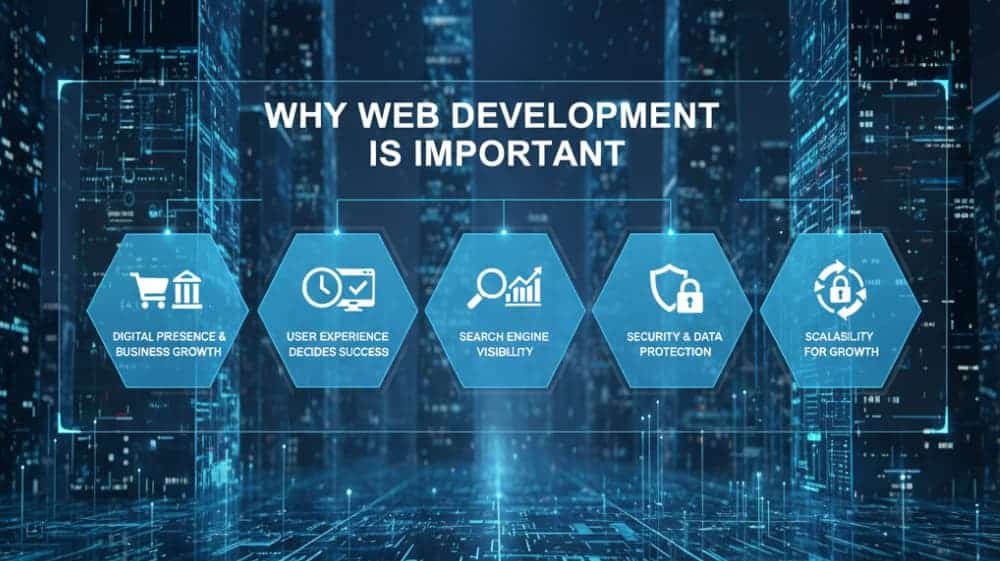
Why Web Development Is Important
Web development has become essential in today's digital world, impacting businesses, consumers, and society in profound ways.
Digital Presence and Business Growth
Every business needs a website today. Your website serves as your digital storefront, operating 24/7 and reaching customers anywhere in the world. Companies without an effective online presence lose opportunities to competitors who invest in quality web development.
E-commerce has fundamentally transformed retail, with online sales growing exponentially year after year. This shift makes web development skills crucial for business survival and growth. Even traditional brick-and-mortar businesses need websites for customers to find their locations, hours, and contact information.
User Experience Decides Success
People judge websites in less than one second. If your site loads slowly, looks unprofessional, or works poorly on mobile devices, visitors leave immediately and rarely return. Quality web development ensures fast loading speeds (under 3 seconds), smooth functionality across all devices, intuitive navigation that helps users find what they need quickly, and professional appearance that builds trust and credibility.Expert UI/UX design plays a crucial role in creating these seamless user experiences.
Search Engine Visibility
Search engines like Google evaluate how websites are built when determining rankings. Well-developed sites with clean code, fast loading speeds, mobile-friendly design, and proper security rank higher in search results. Better rankings mean more visibility, more traffic, and ultimately more customers finding your business online.
Security and Data Protection
Professional web development includes robust security measures protecting your business and customer information. This encompasses encrypted connections (HTTPS) that protect data transmission, secure authentication systems preventing unauthorized access, protection against hacking attempts and vulnerabilities, and safe payment processing for e-commerce transactions. A single security breach can destroy reputation, result in legal consequences, and permanently damage customer trust.
Scalability for Growth
As businesses expand, websites must handle increasing traffic and evolving functionality. Good web development creates scalable architecture that grows with your needs without requiring complete rebuilds. Poor initial development creates technical debt problems that become exponentially more expensive to fix over time.
The Three Types of Web Developers
Frontend Development
Frontend development focuses on everything users see and interact with on their screens. When you visit a website and see beautiful layouts, smooth animations, and interactive buttons, you're experiencing the work of frontend developers.
What Frontend Developers Do:
- Build the visual interface users interact with
- Ensure websites work on phones, tablets, and computers
- Create responsive designs that adapt to different screen sizes
- Implement animations and interactive features
- Optimize performance for fast loading
- Ensure accessibility for users with disabilities
Core Technologies:
- HTML - Structures content and defines elements
- CSS - Styles visual appearance and layouts
- JavaScript - Adds interactivity and dynamic behavior
- React, Vue.js, Angular - Frameworks for complex applications
For example, when you click the "Add to Cart" button on Amazon and watch the cart icon update instantly, that's frontend JavaScript at work.
Backend Development
Backend development handles the behind-the-scenes systems that make websites function. While users never see this work directly, it powers every interaction they have with the site. When you log into Netflix and see personalized recommendations, backend systems retrieved that data specifically for you.
What Backend Developers Do:
- Build server systems and application logic
- Create and manage databases storing information
- Develop APIs connecting different systems
- Handle user authentication and authorization
- Process payments and transactions
- Implement security measures and data encryption
- Optimize performance and scalability
Backend developers also work extensively with databases. Relational databases like MySQL and PostgreSQL organize data in structured tables with defined relationships. NoSQL databases like MongoDB offer flexible document storage for rapidly changing data structures.
Full-Stack Development
Full-stack developers possess expertise in both frontend and backend development, enabling them to work on all layers of web applications. This versatility makes them particularly valuable in startups and small teams where developers often wear multiple hats.
Why Full-Stack Developers Are Valuable:
- Understand the complete picture of how applications work
- Can build entire features from database to user interface
- Bridge communication between specialized team members
- Handle projects independently when needed
- Make better architectural decisions with comprehensive knowledge
However, full-stack developers must continuously learn and update skills across the entire technology spectrum, which requires significant ongoing effort.

How Websites Get Built:
| Phase | What Happens | Typical Duration |
|---|---|---|
| Planning | Define goals, features, budget | 1-2 weeks |
| Design | Create mockups and prototypes | 2-4 weeks |
| Development | Write code and build functionality | 4-12 weeks |
| Testing | Check for bugs and issues | 1-2 weeks |
| Launch | Deploy website live | 1 week |
| Maintenance | Updates, fixes, improvements | Ongoing |
Planning Phase
Every successful project begins with thorough planning. This phase involves understanding what the website needs to accomplish and how it will achieve those goals. Teams identify the target audience through research and user personas. They define essential features and prioritize them based on importance and budget. Competitive analysis reveals what similar sites offer and identifies opportunities for differentiation.
Technical planning includes selecting appropriate programming languages and frameworks, determining hosting requirements and infrastructure needs, planning for scalability as traffic grows, and establishing realistic budgets and timelines.
Design Phase
Design transforms abstract concepts into concrete visual specifications. The process typically progresses through several stages:
Wireframes provide simple sketches showing page layouts and content organization without detailed styling. These help stakeholders agree on structure before investing in detailed design.
High-fidelity mockups
show exactly how pages will look, including colors, typography, images, and branding elements. Professional custom website design services ensure these mockups align with your brand identity and business goals These serve as blueprints for developers during implementation.
Interactive prototypes connect mockups together with clickable links, demonstrating navigation flow and key interactions. Testing prototypes with real users often reveals usability issues far easier to fix before coding begins.
Development Phase
Development is where ideas become reality through code. Frontend developers translate design mockups into HTML, CSS, and JavaScript, building the user interface component by component. They implement responsive behavior ensuring sites work across device sizes, optimize images and code for fast loading, and add interactive features and animations.
Simultaneously, backend developers construct server infrastructure and configure hosting environments. They design database schemas and relationships, create APIs for frontend communication, implement authentication and security measures, and integrate third-party services like payment processors or email systems.
Modern development practices emphasize writing clean, maintainable code with proper documentation, using version control systems like Git to track changes, conducting code reviews to maintain quality standards, and following security best practices from day one.
Testing Phase
Comprehensive testing catches problems before users encounter them:
- Functional Testing - Verifies all features work as intended
- Cross-Browser Testing - Ensures compatibility with Chrome, Firefox, Safari, Edge
- Responsive Testing - Confirms proper function on various screen sizes
- Performance Testing - Measures load times and identifies bottlenecks
- Security Testing - Scans for vulnerabilities and security weaknesses
- Accessibility Testing - Ensures usability for people with disabilities
- User Acceptance Testing - Real users validate the site meets their needs
Launch and Maintenance
Deployment moves the completed website from development servers to production where users can access it. This involves configuring web servers and domain settings, implementing SSL certificates for secure connections, setting up content delivery networks for global performance, and establishing monitoring systems to track uptime and errors.
Maintenance continues indefinitely after launch. Professional website maintenance services ensure regular security updates protect against newly discovered vulnerabilities, while performance monitoring identifies and resolves issues before affecting users. Analytics data reveals how people use the site, informing decisions about improvements. Feature additions and enhancements keep the site competitive and meeting evolving user needs.
Essential Web Development Technologies
Frontend Frameworks:
- React - Component-based library from Meta, widely adopted
- Vue.js - Progressive framework known for approachability
- Angular - Comprehensive framework from Google for enterprise apps
Content Management Systems:
- WordPress - Powers over 40% of all websites globally
- Joomla - Balances flexibility and ease of use
- Drupal - Excels at complex, customized solutions
Development Tools:
- Visual Studio Code - Popular code editor with extensive features
- Git/GitHub - Version control for tracking code changes
- Chrome DevTools - Browser tools for debugging and testing
- npm - Package manager for JavaScript dependencies
Cloud Platforms:
- AWS (Amazon Web Services) - Comprehensive cloud infrastructure
- Google Cloud Platform - Strong in data and machine learning
- Microsoft Azure - Integrates well with enterprise systems
Conclusion
Web development powers the digital experiences billions of people use daily. From simple websites to complex applications, developers create the infrastructure connecting businesses with customers, enabling communication, and facilitating modern digital life.
Whether you're a business owner needing a website or someone considering a career change, understanding web development helps you make better decisions.
Author

Gayan Perera
Gayan Perera, Senior Digital Marketing Specialist at PMGS Digital since 2010. With a bachelor's degree in online systems, Gayan specialises in Online Systems, Web Development, Google Analytics, SEO, Google Ads, Social Ads and CRM Integrations. In addition to those, Gayan enjoys creating videos and content to educate people about those areas.