
Last updated: 19 November 2026
Quick answer: ChatGPT ads are paid, labelled ads that appear below ChatGPT's answers. In Australia they can show to people on the Free and Go plans, and Australian businesses can buy them through OpenAI's self-serve Ads Manager with a minimum daily budget of A$25. For most small businesses, Google Ads should stay the main paid search channel, with ChatGPT ads treated as a small, well-tracked test.
At PMGS, we have tested ChatGPT ads on our own ads account. This guide sticks to what OpenAI publishes about the platform, checked on 17 November 2026, and what a small business should have in place before spending money on it.
What ChatGPT ads are and who sees them in Australia
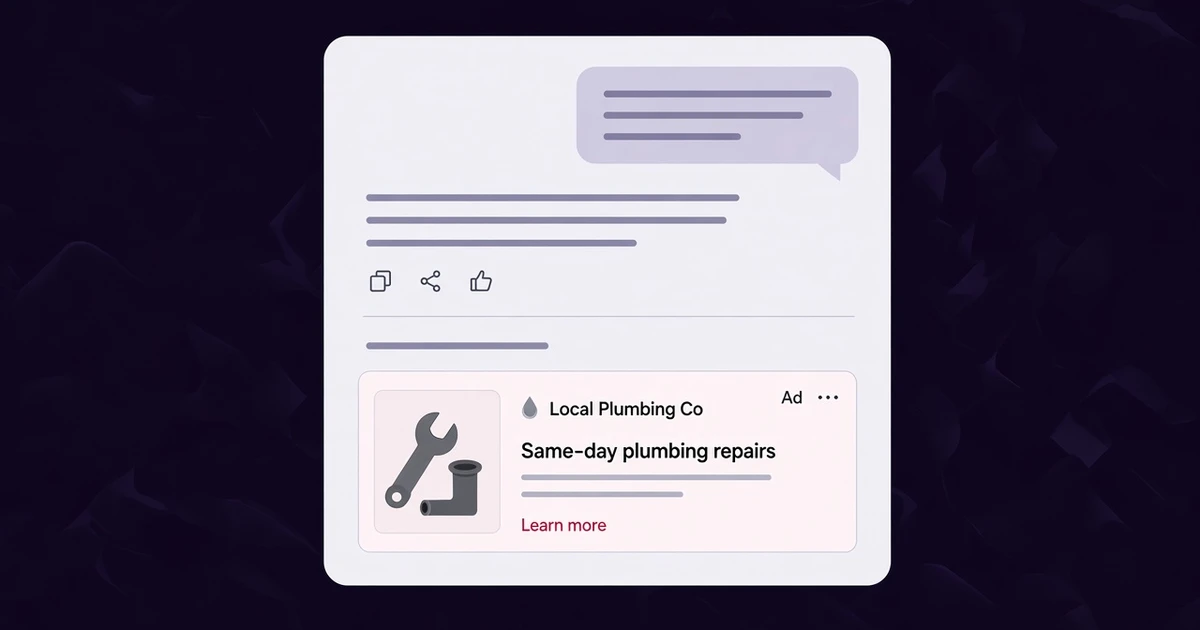
ChatGPT ads are paid placements shown below a ChatGPT response, kept separate from the answer and labelled as ads. In Australia, they can appear for people on the Free and Go plans. Plus, Pro, Business, Enterprise and Edu accounts do not see ads.
OpenAI's help page on ads in ChatGPT also says:
- ads are not shown to accounts identified as belonging to people under 18
- ads shown to logged-out users are limited to ones suitable for all audiences
- Temporary Chats do not show ads
- ads are not eligible to appear near sensitive topics, including personal health, mental health and politics
- Free users can switch to an ads-free option in exchange for lower usage limits
That matters for reach. Paying ChatGPT subscribers never see your ad, so you are reaching only part of the ChatGPT audience.
When ChatGPT ads started in Australia
OpenAI first tested ads in the United States from 9 February 2026. In an update on 26 March 2026 to its announcement about testing ads in ChatGPT, OpenAI said pilots in Australia would begin "in the coming weeks". AdNews then reported that an OpenAI spokesperson confirmed ChatGPT ads started in Australia on 17 April 2026.
You can now buy them yourself. OpenAI's Ads Manager availability page lists Australia as available for self-service, as long as the legal entity that advertises and gets billed is based in Australia.
How ChatGPT ads work: formats, bidding and targeting
ChatGPT ads are matched to the conversation, not to keywords you buy. OpenAI's ad system looks at the topic and intent of the chat, your landing page, your ad text and the context hints you supply, then uses relevance and bids to decide which ad shows.
What an ad looks like
According to OpenAI's guide to the basics of ads in ChatGPT, each ad includes your advertiser name, a small logo (favicon), a headline, a line of description, a landing page and an image. People see one ad unit below a response. OpenAI is also testing a multi-image ad format that shows while ChatGPT generates an image.
Targeting
- Context hints. At the ad group level, you describe the conversations, topics or keywords where your offer may be relevant. OpenAI says these hints guide matching but are not exact-match keywords and do not guarantee delivery.
- Location. OpenAI's guide to creating ChatGPT ads campaigns says you target countries and, where available, states, cities, markets and postcodes. Some new self-serve accounts can at first advertise only in their home country.
- Devices. You can choose Android app, Android web, desktop web, iOS app or iOS web.
- Custom audiences. Including a custom audience requires at least 25,000 matched users, which is likely to be out of reach for most small business customer lists.
If ad personalisation is turned on, OpenAI may also use signals such as past chats and memory to choose ads. Advertisers never see people's chats. They receive aggregated reporting, such as views and clicks.
Campaign objectives and bidding
You choose one of three objectives when you create a campaign:
- Views: you pay per 1,000 impressions.
- Clicks: you pay per valid click.
- Conversions: the system optimises toward a conversion event, such as a lead, but you are still billed per click or per 1,000 impressions, not per conversion.
OpenAI's page on bidding strategies and pricing says new campaigns can use Intelligent bidding, Target CPA (cost per action) or Target CPC (cost per click). Target CPA and Target CPC became available for new campaigns from 9 November 2026. The older Max Bid and Max CPC controls retire for existing campaigns on 1 January 2027. In every case, the final winning auction bid sets the price you pay, and a target is an average goal, not a cap.
What ChatGPT ads cost (and what we still don't know)
OpenAI does not publish a fixed price for ChatGPT ads; you pay through an auction, with a minimum daily budget of A$25 for accounts billed in Australian dollars. At that minimum, a campaign averages about A$175 a week.
The daily budget is an average over a seven-day budget week, not a hard daily limit. OpenAI says spend on a single day can reach up to twice your daily budget, but spend across the week will not exceed seven times it. You can set a campaign-total budget instead if you want a stricter limit on total spend.
A few other cost details from OpenAI's help pages are worth knowing:
- You need a credit card and billing profile set up before ads can deliver.
- Spend figures in Ads Manager can be delayed by 7 to 8 hours, so a zero spend figure does not always mean nothing has been charged.
- Some accounts can start delivering ads before extra business verification is needed. OpenAI's onboarding and policy troubleshooting page says spend can accrue during that time, and the verification threshold is not free advertising credit.
What OpenAI does not publish is an average cost per click or cost per lead for Australia. Any figure you see quoted elsewhere comes from someone's own campaigns, not a rate card. Budget for a test and judge it on your own cost per enquiry.
ChatGPT ads vs Google Ads for a small business
Google Ads shows ads to people as they search, using keywords you choose, while ChatGPT ads show during a conversation, matched to its context. For most local businesses, Google Ads is the more established place to start, because it has years of reporting tools and clear search intent.
| ChatGPT ads | Google Ads (Search) | |
|---|---|---|
| What triggers the ad | The context of the conversation, plus your context hints | Your keywords and match types, compared with the person's search |
| Where it appears | Below a ChatGPT response | Google Search results and related sites in the Google Network |
| Who can see it | Free and Go users, plus logged-out users for all-audience ads; not paid plans or under 18s | People searching on Google |
| How you pay | Per 1,000 impressions or per valid click, set by auction | Mostly per click, set by auction |
| Budget | Minimum average daily budget of A$25 | An average daily budget you choose per campaign |
| Conversion tracking | OpenAI Pixel, Conversions API, UTM parameters | Google tag, Google Analytics imports and phone call tracking |
| Platform stage | Ads Manager is labelled Beta by OpenAI | Long-established |
| Best fit for a small business | A small, separate test once tracking works | The core paid search channel for local enquiries |
If you are still building your search campaigns, start with Google Ads management and get your cost per enquiry stable first. ChatGPT ads can then be tested against a clear benchmark.
Gayan Perera's approach at PMGS is to start ChatGPT ads with a small test spend rather than move budget across in one go. Judge the test on the data, and only increase spend if it performs. He also doesn't want to miss out on a new channel, and a small test lets you learn how it works early.
 Illustration: Google Ads responds to a search, while ChatGPT ads sit below a conversation.
Is your business ready? A pre-launch checklist
Work through these five checks before you create a campaign.
- Check your industry is allowed. OpenAI's ad policies (updated 10 September 2026) say ads are mainly limited to consumer categories such as lifestyle and household goods, local services, travel and experiences, and digital products or education. Alcohol, gambling, dating and political ads are not allowed. Outside the United States, legal services and many health categories are not allowed, and financial services are generally prohibited or limited to select approved advertisers.
- Set up conversion tracking first. OpenAI's conversion measurement guide says you send conversion events with the OpenAI Pixel, the Conversions API or both. You can also add UTM parameters to your landing page links so ChatGPT traffic shows up in your existing analytics. Our guide to tracking ROI in digital marketing campaigns explains why this comes first.
- Check your privacy notice and consent. OpenAI says conversion data should only be sent after you have clearly told people what you collect and obtained any consent the law requires.
- Send people to a landing page that matches the ad. OpenAI's policies apply to your ad copy, images and landing page together. An approved ad cannot link to a page that introduces content OpenAI doesn't allow.
- Only make claims you can prove. OpenAI prohibits misleading ads, including unfounded claims about pricing, outcomes or comparisons. Under Australian Consumer Law, the ACCC says claims must be true, accurate and based on reasonable grounds, and a business must be able to prove any claim it advertises. This is general information, not legal advice.
At PMGS, tracking always comes first. Before any new channel goes live, we add UTM parameters to every ad link so each visit and enquiry can be traced back to the campaign that sent it.
When to test ChatGPT ads and when to wait
A ChatGPT ads test makes more sense when:
- your industry sits in a category OpenAI allows in Australia
- conversion tracking already works on your website
- your Google Ads or other paid channels are already producing enquiries at a cost you understand
- you can set aside a separate test budget without cutting a channel that already works
- your customers tend to research and compare before they buy
It is usually better to wait when:
- your industry is restricted or not allowed outside the United States
- you cannot yet measure enquiries, calls or sales from paid traffic
- your monthly ad budget is already stretched across one channel
- you need a guaranteed result in a short time, because OpenAI itself labels Ads Manager a beta and its bidding options are still changing
Our clients do ask about ChatGPT ads. Most are interested but unsure whether the channel will work for their business, which is exactly why a small, measured test is the sensible first step.
On industries, we don't have a blanket list to avoid. Check your category against OpenAI's ad policies before you plan anything, because the rules for Australia differ from the United States and can change.
What we have tested so far
We have run a ChatGPT ads campaign on PMGS's own ads account, and it showed modest early results. We have not run ChatGPT ads for clients yet.
Ads in ChatGPT vs showing up in ChatGPT answers
Paying for a ChatGPT ad does not get your business mentioned in ChatGPT's answers. OpenAI says ads run on separate systems from its chat model, and advertisers cannot shape, rank or alter ChatGPT's responses.
Being named inside an answer is an organic visibility job. It depends on clear service pages, accurate business details and content AI tools can understand. If that is the result you want, see how AI search optimisation for Australian businesses works, or read our guide to SEO vs GEO vs AEO for small businesses.
The two can work together: paid ads give you reach you can switch on and off, while organic work helps AI answers describe your business accurately.
Frequently asked questions
Can businesses advertise on ChatGPT in Australia?
Yes. OpenAI lists Australia as available for self-service Ads Manager, as long as the business that advertises and is billed is based in Australia. Your industry must also be allowed under OpenAI's ad policies, and some accounts need business verification.
How do you create ads in ChatGPT?
You sign in at ads.openai.com with an OpenAI account, then either enter your website URL so Ads Manager can draft a first ad, or skip straight to Ads Manager. You add your advertiser details and billing, then build a campaign with ad groups and ads. Ads only go live once they pass OpenAI's review.
Is ChatGPT good for advertising?
It can suit some businesses, but it is still a new channel. OpenAI's advertiser help pages don't list average costs or results, and paying ChatGPT subscribers don't see ads. Treat it as a measured test alongside proven channels, not a replacement for them.
What is the best place to advertise for a small business?
There is no single best place. For local service businesses, Google Ads often comes first because people are actively searching for the service. Other channels, such as Meta ads, suit different goals, and ChatGPT ads can be tested once tracking and a working channel are in place.
What are the legal consequences of false advertising in Australia?
The ACCC says businesses must not make false or misleading claims, whether or not they mean to mislead, and penalties can apply. That covers ads on any platform, including ChatGPT. For advice about a specific claim, speak to a lawyer.
Get a free strategy call
Thinking about ChatGPT ads, or not sure your current ad spend is working? Talk to the PMGS team in Melbourne about your paid media and PPC management. We will look at where your budget goes now and whether a small ChatGPT ads test makes sense for your business.
Author

Gayan Perera
Gayan Perera is a Senior Digital Marketing Specialist at PMGS Digital, which was established in 2014, and has worked in digital marketing since 2010. With a bachelor's degree in online systems, Gayan specialises in Online Systems, Web Development, Google Analytics, SEO, Google Ads, Social Ads and CRM Integrations. In addition to those, Gayan enjoys creating videos and content to educate people about those areas.